AgentFlight
Watch local trust while your coding agent works, then prove the result with one Review Passport.
- Platform
- Node.js 20+, macOS, Linux, Windows
- Pricing
- Free CLI, Apache-2.0
Overview
- Version
- 0.16.1
- Downloads
- 6.0k total
- Updated
- 29 Jun 2026
- Category
- Developer Tools / Agentic engineering
- Platform
- Node.js 20+ (macOS, Linux, Windows)
- License
- Apache-2.0
AgentFlight is a local-first review layer for coding-agent sessions, the control room around your agent rather than another agent. It works alongside tools like Codex, Claude Code, Cursor, Windsurf, Gemini CLI, Aider, and OpenCode. Run agentflight guard beside the agent and it watches the local trust state as the work happens: readiness, changed files, verification counts, proof gaps, scope drift, Baseframe gates, the trust signals worth acting on, and the one next action. Guard reads the same local evidence as status and never runs hidden commands or sends source anywhere; in one-shot mode it exits non-zero whenever the work is not ready, so you can wire it into a loop.
When the work is ready, agentflight finish writes the proof. It produces one Review Passport, as JSON and Markdown, the single artifact a reviewer reads first, and bundles the handoff, report, replay, and resume beside it, then prints the artifact paths and the next action. The passport carries readiness, the changed files, the verification runs, proof gaps, review focus, reviewer routes, the artifact paths, and integrity fingerprints, and it stores source-free metadata only: paths, commands, statuses, counts, timestamps, artifact paths, and hashes. Behind it, a Review Contract turns the session's signals into explicit claims with source-free claim-to-proof references, a Trust Delta summarizes what moved in the trust state, a review queue orders what to inspect first, and role-aware routing gives maintainers, verification, security, Docs/DX, and release reviewers their own local path. agentflight handoff remains available for a lighter packet, and agentflight history reopens recent local sessions. AgentFlight does not call an LLM, upload source code, or replace your coding agent, and if verification is interrupted it records that uncertainty instead of pretending the session is ready.
ProjScan finds the risk, AgentLoopKit controls the work, and AgentFlight proves the result. In a Baseframe session, AgentFlight reads local ProjScan repository assessment evidence and AgentLoopKit task contract evidence from versioned JSON under .baseframe/, checks the session against the expected scope and required verification, computes readiness, and agentflight finish also writes .baseframe/evidence/<task-id>/agentflight-result.json for AgentLoopKit to reconcile. The link is file-based, so AgentFlight stays independently usable and imports neither tool's internals. TokenTrace tracks what your AI CLIs cost. AgentFlight is the review layer over the session, the proof trail you read before you trust the work.
Part of Baseframe Labs
Four tools, four questions.
Baseframe Labs is four developer tools, each answering a different question about your work, in the order the work happens. Each one stands on its own.
- 01
 ProjScanIs the repository healthy?
 - 02
 AgentLoopKitWhat should the agent do next?
 - 03AgentFlightWhat did the agent actually do?
- 04
 VerisKitCan we trust the result?
Three of them, ProjScan, AgentLoopKit, and AgentFlight, also hand off through versioned JSON under .baseframe/. VerisKit verifies a change on its own and needs none of the others.
Features
What it does well.
Live Trust Monitor
04- agentflight guard
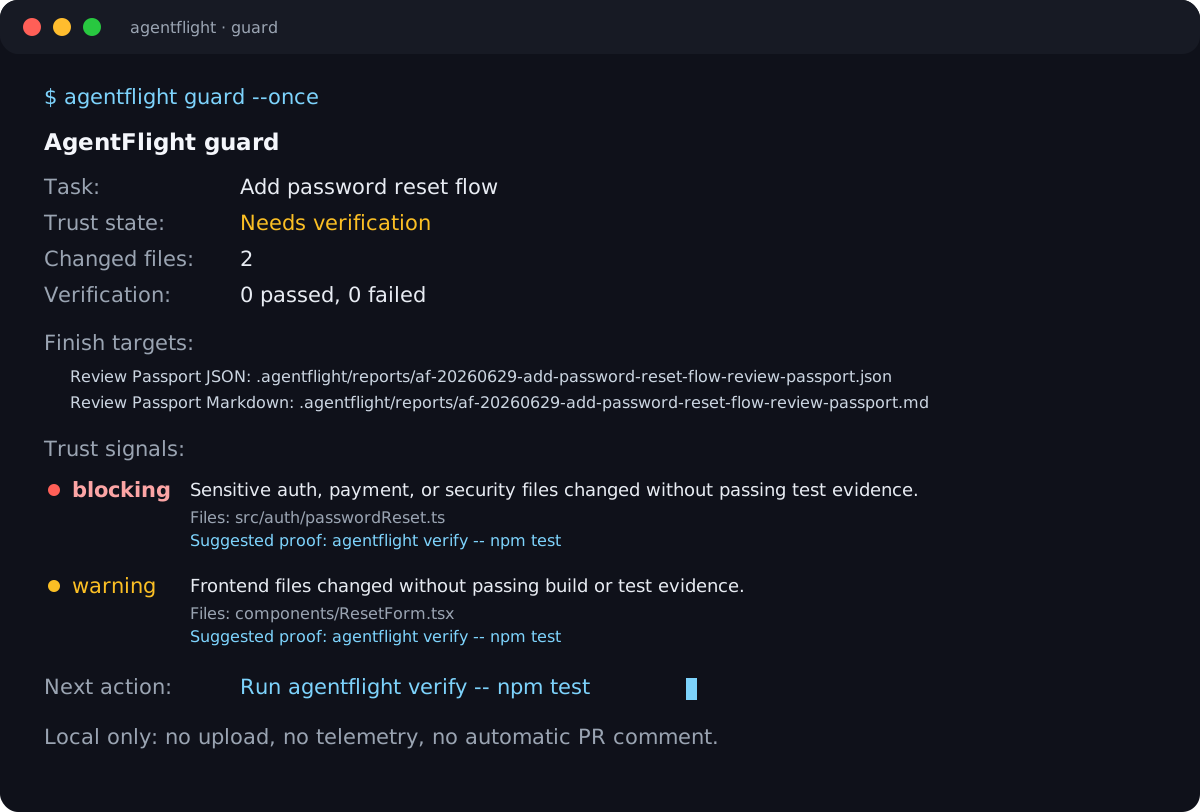
- Run Guard beside your coding agent and it watches the local trust state as the work happens: readiness, changed files, verification counts, proof gaps, scope drift, Baseframe gates, the trust signals worth acting on, and one next action.
- Watch or one-shot
agentflight guardrefreshes on an interval;guard --onceprints a single summary and exits. One-shot exits 0 only when readiness is ready for review or a clean worktree, so it drops into a loop or a pre-finish gate.- JSON for your own tooling
guard --format json --onceemits a structured summary: readiness, changed files, verification counts, the Review Passport and Baseframe artifact hints, and Baseframe gate counts, for scripts and dashboards you control.- Reads, never runs hidden commands
- Guard reads the same local evidence as
statusand never runs verification commands or sends source anywhere. Useagentflight verifyto capture proof, then Guard reflects it.
Finish & Review Passport
04- agentflight finish
- Run
agentflight finishat the end of a session and it writes the Review Passport, handoff, report, replay, and resume artifacts in one command, then prints the paths and the next action. - Review Passport
- One artifact, JSON and Markdown, that tells reviewers whether the work is ready: readiness, changed files, verification runs, proof gaps, review focus, reviewer routes, artifact paths, and integrity fingerprints.
- Source-free by design
- The passport stores metadata only: paths, commands, statuses, counts, timestamps, artifact paths, and hashes. No upload, no telemetry, no PR posting, and no source contents in the passport.
- Baseframe result on finish
- In a Baseframe session,
agentflight finishalso writes.baseframe/evidence/<task-id>/agentflight-result.jsonand updates the agentflight status in.baseframe/agent-workflow.jsonfor AgentLoopKit to reconcile.
Baseframe Suite
08- Baseframe Suite Integration v1
- Reads ProjScan and AgentLoopKit evidence from
.baseframe/JSON and emits a result artifact for AgentLoopKit to reconcile, without importing either tool's internals. - Start from a task contract
agentflight start --from-taskopens a session from an AgentLoopKit task, carrying its scope, acceptance criteria, and verification gates.- Linked ProjScan assessment
- Resolves the task's
sourceAssessment.pathto read the matching ProjScan repository assessment beside it. - Scope drift detection
- Compares changed files against the task's allowed and excluded paths and flags work that lands outside the boundary.
- Verification gate reconciliation
- Marks each required gate satisfied, failed, or still missing against the proof the session captured.
- Unified readiness
- Folds repository assessment, task contract, scope, and gates into one ready, needs verification, or blocked call.
- Finish and result artifact
agentflight finishwritesagentflight-result.jsonand updates the agentflight status in.baseframe/agent-workflow.jsonfor AgentLoopKit to reconcile.- ProjScan and AgentLoopKit adapters
- Uses ProjScan for repo intelligence and AgentLoopKit for task discipline, and keeps recording when either tool is absent.
Proof & Verification
07- Project Review Contract
- A repo-specific proof standard in
.agentflight/config.jsonthat maps each changed-file category to the proof it requires. - Proof before trust
- Shows required, accepted, current, stale, failed, and missing proof side by side for the change in front of you.
- Verification evidence
agentflight verify -- <command>records the command, timing, exit code, pass or fail, and the stdout and stderr paths.- Inline failure excerpts
- On a failed check, prints a short stderr-first excerpt in the terminal, report, and replay, and preserves the raw logs.
- Proof freshness
- Snapshots changed files so a later edit flips proof from current to stale and holds readiness until you rerun the check.
- Incomplete verification detection
- Treats a verify run that never finishes as a blocking proof gap and names the command to rerun.
- Heartbeat for long verification
- Prints a small heartbeat while a long command runs, and keeps it out of the captured evidence.
Review Intelligence
08- Review Intelligence
- Ranks the changed files worth reviewing first and states whether the work is ready, needs verification, or blocked.
- Review Contract
- A deterministic local claim ledger that marks each claim supported, needs review, failed, stale, or unknown, and points to its proof.
- Trust Delta
- A short readout of what moved in the trust state: failed, stale, or missing proof, manual review, and repo-history under-proofing.
- Review queue
- One ordered list of proof reruns, missing-proof commands, manual checks, and files to inspect first.
- Review receipts
handoff --acceptrecords a local receipt that goes stale when an unresolved failure or a new changed file lands after acceptance.- Role-aware routing
- Gives Maintainer, Verification, Docs/DX, Security, and Release reviewers each their own path through the session.
- Repo-calibrated guidance
- Compares this session's proof with recent local ready handoffs and suggests the proof command similar changes usually carried.
- Quieter review surfaces
- Caps noisy review-focus and changed-file lists with a remaining count instead of silently dropping rows.
Workflow & Artifacts
07- Session recording
agentflight startcaptures task, branch, commit, dirty state, package manager, and detected tools as context for every later artifact.- Local handoff packet
agentflight handoffremains available for a lighter packet: it leads with a decision, then bundles the report, replay, and resume. Reach forfinishwhen you want the full Review Passport.- Replay evidence ledger
agentflight replaywrites a self-contained HTML record: readiness, risk, review focus, proof gaps, timeline, and a pass or fail ledger.- Report and resume artifacts
reportwrites a Markdown proof report, andresumewrites a Codex or Claude-ready continuation prompt with state and guardrails.- Local session history
agentflight historylists recent sessions with proof counts and artifact paths, and--limit 1reopens the latest.- Snapshots
agentflight snapshot --note "..."records a checkpoint with git state, changed files, risk level, and a verification summary.- Doctor checks
agentflight doctorchecks Node, npm, git, your package manager, config, writable paths, the active session, ProjScan, and AgentLoopKit.
Trust & Privacy
02- Local-first privacy
- Stores human-readable files under
.agentflight/, git-ignored by default. No account, no upload, no telemetry, and no LLM calls. - First-run workspace hygiene
initwrites a.agentflight/.gitignore, leavesconfig.jsoncommittable, and filters AgentFlight's own artifacts out of review.
See it in action
A closer look.
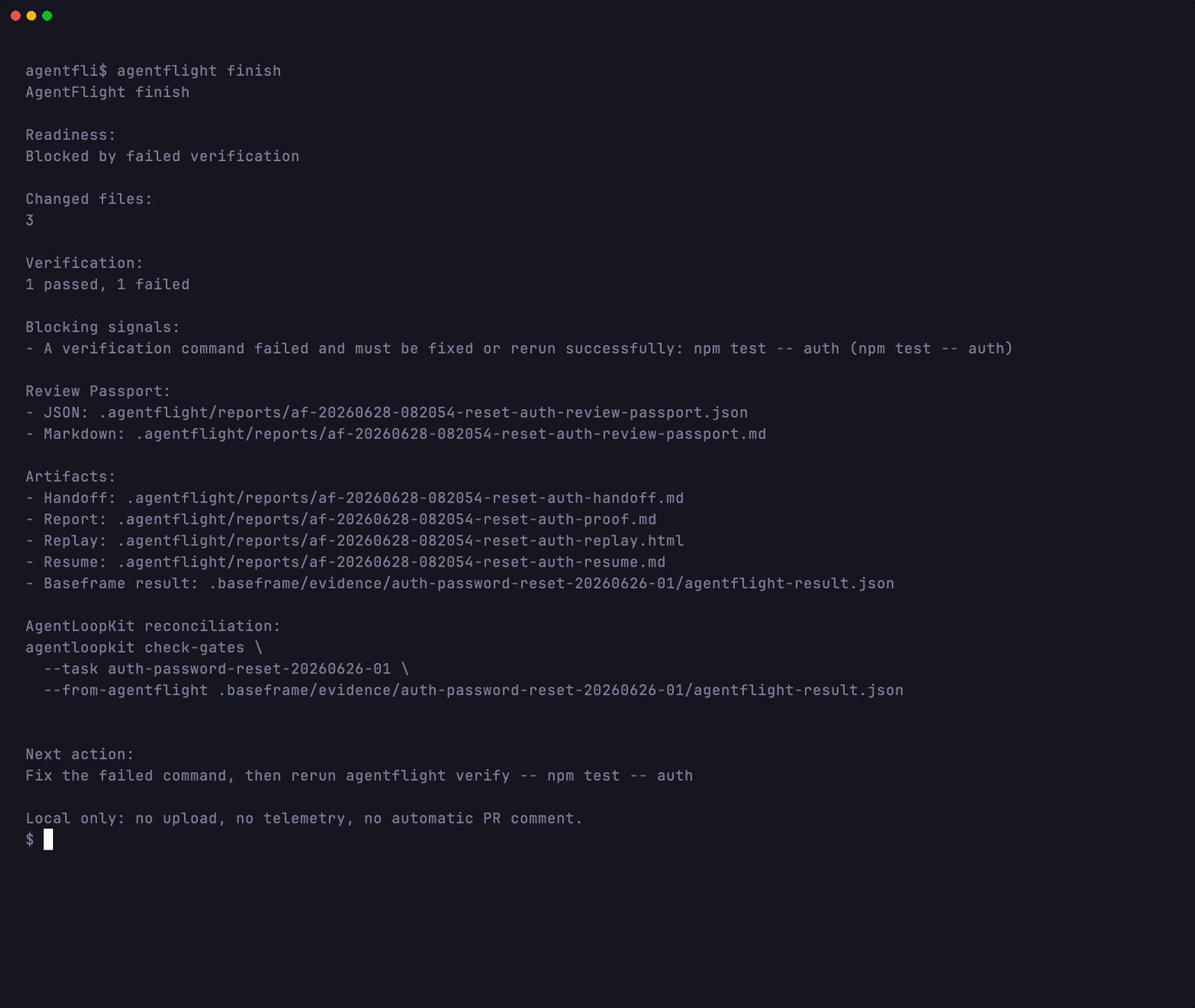
Guard watches; finish proves the result
Where Guard is the live monitor, agentflight finish writes the final evidence: the Review Passport, as JSON and Markdown, plus the handoff, report, replay, and resume, and in a Baseframe session the agentflight-result.json. Real agentflight finish output: blocked readiness, three changed files, one passed and one failed verification, the artifact paths, and the next action.
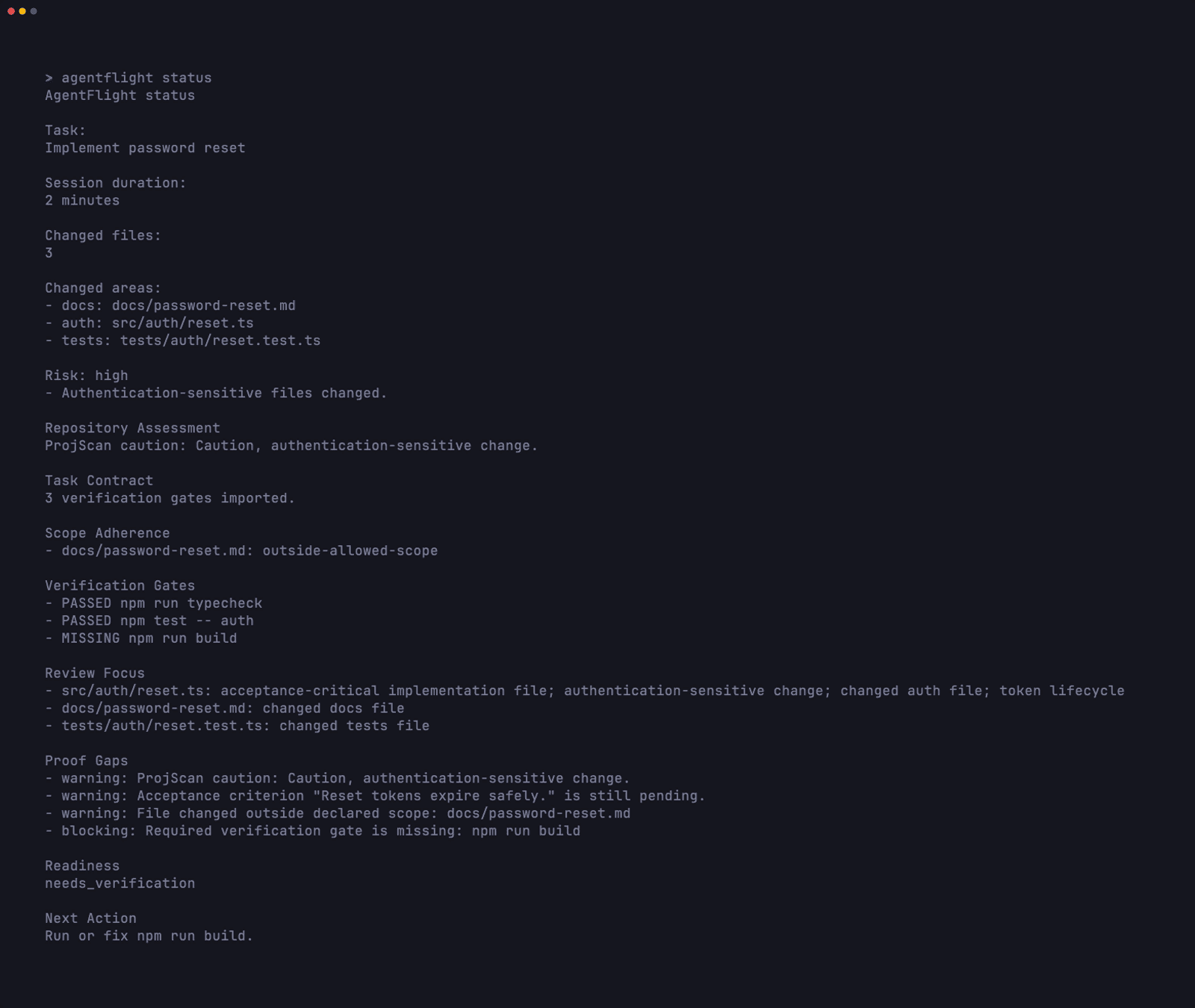
Readiness across the Baseframe Suite
Real AgentFlight Baseframe status output showing ProjScan repository risk, AgentLoopKit verification gates, scope drift, proof gaps, readiness, and next action.
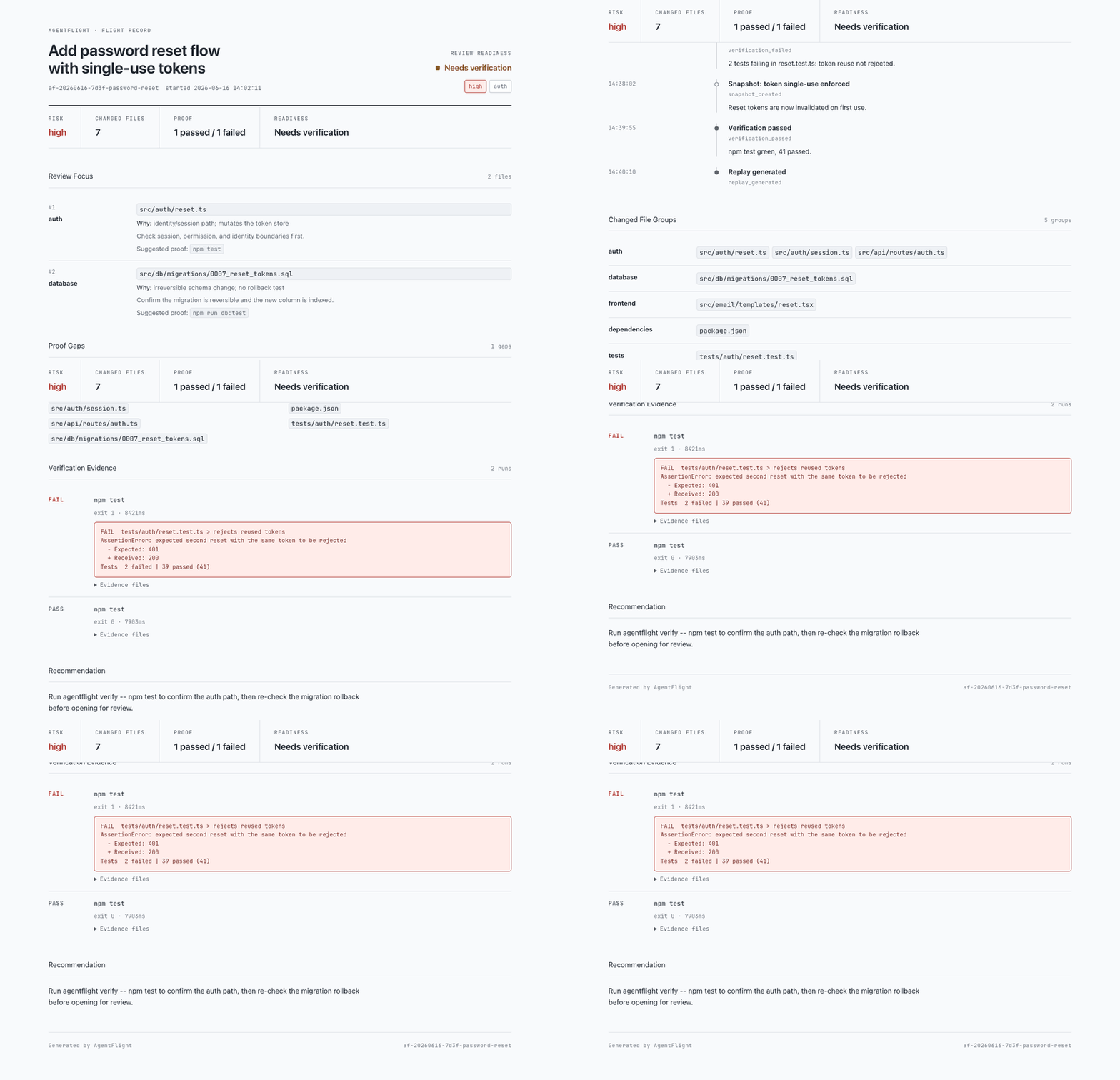
A flight-record evidence ledger
agentflight replay writes a self-contained HTML record that leads with review readiness, then a risk readout, ranked review focus, proof gaps, the session timeline, and a pass or fail verification ledger with inline excerpts for failed runs. Open it in a browser, with no server and no upload.
New in 0.16.0
agentflight guard, the live trust monitor.
AgentFlight Guard watches local trust while coding agents work; the Review Passport proves the final result. ProjScan finds the risk, AgentLoopKit controls the work, AgentFlight proves the result. 0.16.0 leads with agentflight guard: run it beside your agent and it refreshes the local trust state, readiness, proof gaps, scope drift, Baseframe gates, and one next action, without running hidden commands or sending source anywhere. When the work is ready, agentflight finish writes the Review Passport.
- Guard, the live monitor
agentflight guardwatches the trust state as the agent works: readiness, changed files, verification counts, proof gaps, scope drift, Baseframe gates, the trust signals worth acting on, and the one next action. It reads the same local evidence asstatusand runs no hidden commands.- Watch, one-shot, or JSON
agentflight guardrefreshes on an interval,guard --onceprints one summary and exits, andguard --format json --onceemits a structured summary. One-shot exits 0 only when readiness is ready for review or a clean worktree, so it fits a loop or a pre-finish gate.- Guard reflects proof, verify captures it
- Guard never creates proof.
agentflight verify -- <command>records the command, timing, exit code, pass or fail, and the stdout and stderr paths, and Guard updates the moment that proof lands. - Finish writes the Review Passport
- When the work is ready,
agentflight finishwrites.agentflight/reports/<session-id>-review-passport.jsonand.mdplus the handoff, report, replay, and resume. In a Baseframe session it also writes.baseframe/evidence/<task-id>/agentflight-result.jsonfor AgentLoopKit to reconcile. - Source-free, local-only
- Guard and the passport store metadata only: paths, commands, statuses, counts, timestamps, artifact paths, and hashes. No source upload, no telemetry, no PR posting, no login, and no LLM calls.
Baseframe Suite
Baseframe Suite Integration v1.
ProjScan finds the risk, AgentLoopKit controls the work, and AgentFlight proves the result. AgentFlight now reads local ProjScan and AgentLoopKit evidence from versioned JSON under .baseframe/, checks the session against the expected scope and required verification, and writes a result artifact AgentLoopKit can reconcile. The link is file-based: AgentFlight stays independently usable and imports neither tool's internals.
- Start from an AgentLoopKit task
agentflight start --from-task <task.json>opens a session from a task contract, carrying its scope, acceptance criteria, and required verification gates.- Linked ProjScan assessment resolution
- When the task contract references a ProjScan assessment, AgentFlight resolves it through
sourceAssessment.pathand reads the repository assessment evidence beside it, so the session knows the risk context the task was built from. - Scope drift detection
- AgentFlight compares the files the session changed against the task's allowed and excluded paths, and flags scope drift when work lands outside the agreed boundary or misses a required area.
- Verification gate reconciliation
- AgentFlight reconciles each required verification gate against the proof the session captured, so a gate reads satisfied, failed, or still missing rather than assumed.
- Unified readiness
- Repository assessment, task contract, scope adherence, and verification gates fold into one readiness call, so the suite reports a single ready, needs verification, or blocked state rather than four separate ones.
- Finish and emit the result
agentflight finishwrites.baseframe/evidence/<task-id>/agentflight-result.jsonand updates the agentflight status in.baseframe/agent-workflow.json, handing AgentLoopKit a versioned artifact to reconcile. Local JSON only: no cloud, no telemetry, no source upload.
Review workflow
Trust Delta, a review queue, and review receipts.
0.13.0 sharpens the review surface. AgentFlight now summarizes what changed in the trust state, orders what to inspect first, lets a handoff be accepted and later marked stale, and routes each reviewer to their own path.
- Trust Delta shows what changed in the trust state
- A short readout of failed proof, stale proof, missing proof, manual review, and repo-history under-proofing, read from existing local metadata. It appears in status, the handoff, the report, the replay, and resume.
- A review queue orders what to do first
- One ordered list of proof reruns, missing-proof commands, manual checks, repo-calibration guidance, and file inspection. It shows up in the surfaces you already read, so there is no new command and no separate dashboard.
- Review receipts can be accepted, then go stale
agentflight handoff --acceptrecords a local review receipt. It reads current until an unresolved verification failure or a new changed file lands after acceptance, then goes stale, so an accepted handoff cannot quietly drift.- Role-aware routing points each reviewer at their path
- Status, the handoff, the report, the replay, and resume show Maintainer, Verification, Docs/DX, Security, and Release review paths, built from existing source-free Review Intelligence signals.
- Review surfaces stay quiet without losing detail
- Review focus and changed-file lists now cap noisy output and mark when rows are capped, with a remaining count, instead of silently omitting lower-priority files. The full detail stays in the report and replay.
Review Contract
A claim-by-claim ledger of what to trust.
AgentFlight turns a session's signals into explicit claims and points each one at the local proof behind it, so a reviewer reads what is supported, what still needs review, what should not be trusted yet, and where the proof for each claim lives.
- Every claim carries a status
- Each claim reads as supported, needs review, unsupported, failed, stale, not testable, or unknown. Supported means a passed verification command backs it. Stale means the proof predates a later change. The ledger is deterministic and built locally.
- Every claim points at its proof
- Each claim carries source-free proof references: the changed files behind it, the proof status, any proof gaps, the readiness reason, or the suggested verification command. A reviewer follows the reference to the proof instead of trusting a summary, and a compact review path orders the claims so the highest-friction ones come first.
- It shows up where you already look
- The same claims surface in
agentflight status,report,replay,resume, andhandoff. No new command to learn, no separate dashboard, no cloud call. - What a clean session reads like
- Task: supported. Changed files: supported. Verification: supported. Proof gaps: none. Readiness: ready for review. A session with an unverified change instead reads needs review on that file and holds readiness at needs verification.
Review Intelligence
Where to review first, and what proof is missing.
After a session, AgentFlight ranks the changed files worth reviewing first, shows which verification proof exists, flags the gaps, and states whether the work is ready. Every readiness call points at the next command.
- Review first
- Ranked changed files, most review-sensitive first. Example:
src/auth/session.ts, flagged as an auth-sensitive path with no matching test evidence. - Proof, and proof gaps
- Captured verification commands sit next to the gaps. Example gap:
npm testwas started but no completed result was recorded. - Readiness and next action
- Each session reads as ready, needs verification, or blocked. A needs-verification session names the command to run next:
agentflight verify -- npm test. Ranking is deterministic and runs locally.
Finish
One command writes the review packet.
agentflight finish is the end-of-session command. It writes the Review Passport, the single artifact that tells reviewers whether the work is ready, and bundles the handoff, report, replay, and resume beside it. agentflight handoff stays available for a lighter packet.
- Readiness, gaps, and focus
- The Review Passport states whether the session is ready, needs verification, or is blocked, lists the proof gaps, ranks review focus, names reviewer routes, and shows failed verification excerpts. A reviewer opens the passport first and the report, replay, or resume only when they need detail.
- Accept it, and watch it go stale
agentflight handoff --acceptrecords a local review receipt for a ready handoff. The receipt reads current until an unresolved verification failure or a new changed file lands after acceptance, then goes stale across status, handoff, report, replay, resume, and history.- Reopen it later with history
agentflight historylists recent local sessions with proof counts and artifact paths, andagentflight history --limit 1reopens the latest handoff, report, replay, or resume. Read-only and local: no index, no sync, no session switching.- Proof without pretending
- AgentFlight stores passed commands, failed commands, exit codes, stdout, stderr, durations, and a short failure excerpt for failed runs as local evidence. It does not claim a test passed unless the command passed.
Trust
Local files. No telemetry. No cloud upload.
AgentFlight reads git status and package metadata, runs verification commands only when you ask, and writes local artifacts under .agentflight/. Reports include filenames and summaries by default, not full code diffs.
- Nothing leaves the machine
- No cloud, no telemetry, no source upload, no LLM calls, no account, and no automatic PR comments. AgentFlight reads git status and package metadata, runs verification only when you invoke it, and writes local files under
.agentflight/. - What AgentFlight is not
- Not a coding agent, not a cloud service, not a replacement for tests, not a security scanner, not a CI platform, and not a code review replacement.
- Records, never overwrites your work
- AgentFlight captures context and writes its own artifacts under
.agentflight/. It runs your verification commands only when you invokeverify. - Where it sits in the studio
- AgentFlight is the user-facing review layer and proof trail. ProjScan is the repo intelligence engine, AgentLoopKit is the task discipline and verification workflow engine, and TokenTrace is local AI CLI usage analytics.
Watch the trust, then prove the result.
One workflow runs from the first agent prompt to a local review packet. Init once, start the session, then keep agentflight guard open beside your coding agent to watch the trust state, capture proof with verify, snapshot the milestone, and when Guard reads ready, agentflight finish writes the Review Passport with the handoff, report, replay, and resume beside it. Local-first, Apache-2.0, no cloud.
Initialize in a repo
Start a session
Watch local trust
Capture verification
Snapshot the milestone
Write the Review Passport
More from the studio
ProjScan
ProjScan tells reviewers when to bootstrap, prove, or stop. Review Gate returns one decision; bootstrap is explicit. Local proof, no code upload.
ViewAgentLoopKit
The local control plane for low-token, verifiable agent loops. It owns scope, gates, and completion decisions, with a token receipt on every step.
ViewVerisKit
veris runs the test and quality tools you already have, then returns one honest verdict, verified, failed, or partial, plus a PR-ready report.
View