AgentLoopKit
Repo-native control for software-agent work: scoped tasks, guarded loop iterations, and verification gates that produce review-ready evidence a reviewer can approve or reject in a single pass.
- Platform
- Node.js 20+, macOS, Linux, Windows
- Pricing
- Free (MIT)
Overview
- Version
- 1.2.0
- Downloads
- 15k total
- Updated
- 14 Jul 2026
- Category
- Developer Tools / Agentic engineering
- Platform
- Node.js 20+ (macOS, Linux, Windows)
- Distribution
- npm / npx
- CLI
- agentloop, agentloopkit
- License
- MIT
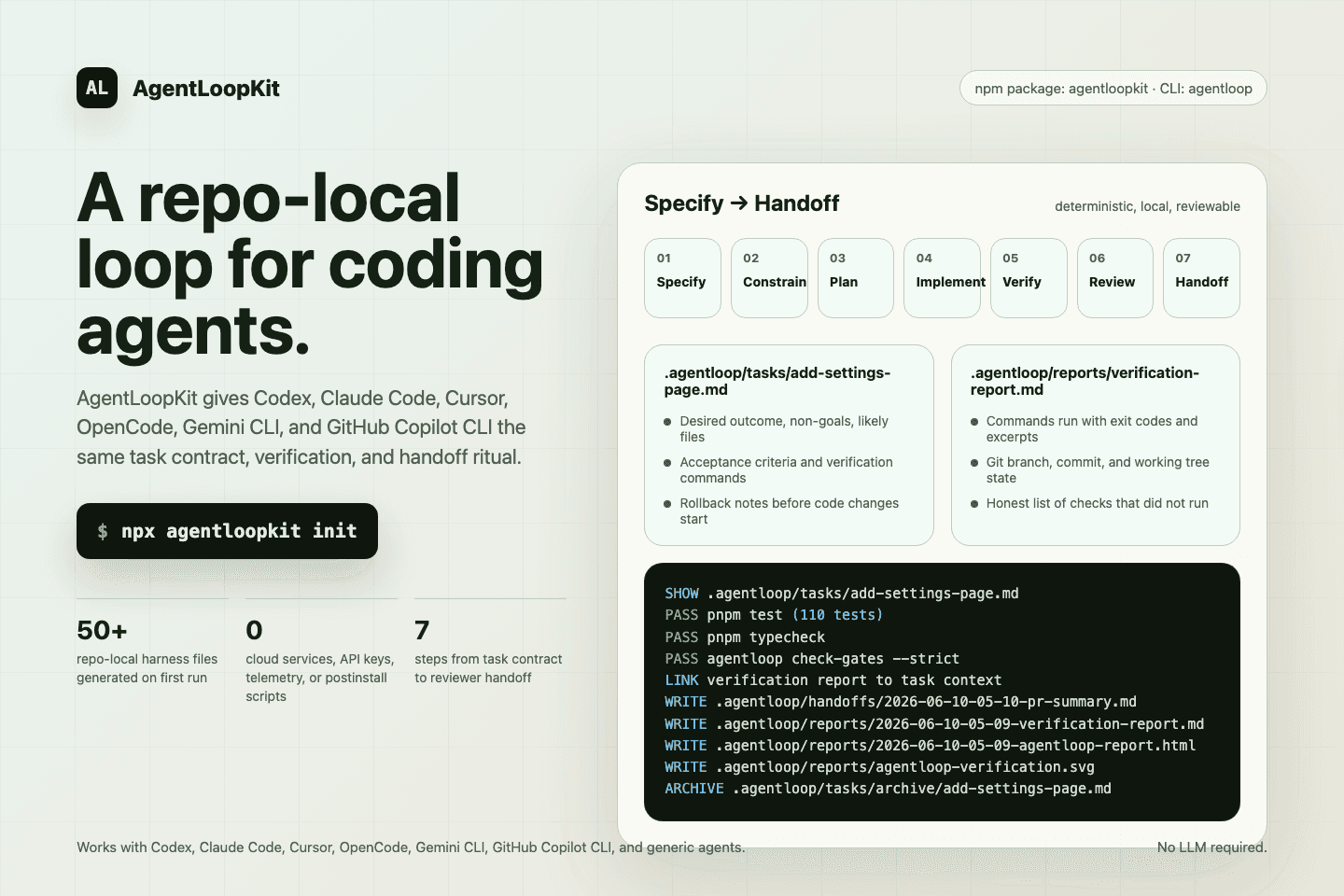
AgentLoopKit is the local control plane for low-token, verifiable agent loops. In the Baseframe Suite, ProjScan finds the risk, AgentLoopKit controls the work, and AgentFlight proves the result. Drop it into any repo and it owns the middle of that loop: task scope, acceptance criteria, verification gates, and completion decisions. agentloop loop create, loop tick, loop status, and loop report drive a controlled loop; agentloop loop scorecard reads the loop before another iteration runs and returns one read-only decision (continue, ask-human, stop, or ready); agentloop loop run executes one configured runner iteration, shell-free, while AgentLoopKit stays controller-only and owns the goal, scope, context budget, gates, evidence, stop conditions, and readiness decision; agentloop start --for codex --goal implement hands an agent a read-only preflight before the first edit; agentloop ready returns a decisive readiness gate; and around them sits a reviewable engineering loop of task contracts, the Context Contract, verification evidence, a drift and proof-debt guard, evidence maps, review-readiness checks, PR handoffs, and run history. It works with Codex, Claude Code, Cursor, OpenCode, Gemini CLI, GitHub Copilot CLI, and generic agents without replacing them.
Run npx agentloopkit init inside an existing repo. AgentLoopKit writes AGENTS.md, AGENTLOOP.md, agentloop.config.json, and .agentloop/ templates for tasks, loops, gates, policies, reports, handoffs, agent instructions, and local run evidence.
It stays local-first: no cloud backend, no telemetry, no postinstall script, no API key, no hidden network calls, and no LLM required.
Part of Baseframe Labs
Four tools, four questions.
Baseframe Labs is four developer tools, each answering a different question about your work, in the order the work happens. Each one stands on its own.
- 01
 ProjScanIs the repository healthy?
 - 02AgentLoopKitWhat should the agent do next?
- 03
 AgentFlightWhat did the agent actually do?
 - 04
 VerisKitCan we trust the result?
Three of them, ProjScan, AgentLoopKit, and AgentFlight, also hand off through versioned JSON under .baseframe/. VerisKit verifies a change on its own and needs none of the others.
Features
What it does well.
Loop control
05- Score the next loop
agentloop loop scorecardreads the loop contract, readiness gates, scope evidence, runner guardrails, token budget, and context handles, then returns one read-only decision (continue, ask-human, stop, or ready) with ranked reasons, before another iteration spends budget.- Drive the loop
agentloop loop create,loop tick,loop status, andloop reportopen a controlled loop, advance it one verified step at a time, show where it stands, and write a loop report.- Guarded loop run
agentloop loop runexecutes one configured runner iteration, shell-free, blocking destructive, publish, and git state-changing commands. AgentLoopKit stays controller-only and records the exit code, bounded output, changed files, a token receipt, and the loop decision.- Readiness gate
agentloop readyreturns a decisive ready or not-ready answer from local evidence, so an agent or a reviewer knows whether work can proceed or complete before acting.- Token receipts
- Every loop step prints a token receipt: estimated broad context, compact context, AgentLoopKit overhead, and the net context reduction. Local planning estimates, not provider billing.
Preflight
02- Start preflight
agentloop start --for codex --goal implementhands an agent the active task, risk, verification state, and next safe command before it edits, read-only.- Context Contract
agentloop context budget,pack, andshowmeasure context pressure, build an auditable continuation pack, and expand source handles back to full local evidence.
Task & Verification
03- Task contracts
agentloop create-taskwrites a scoped Markdown contract: outcome, acceptance criteria, non-goals, likely files, protected files, verification commands, and rollback notes.- Verification evidence
agentloop verifyruns the repo's configured checks and writes a dated report under.agentloop/reports/, keeping exit codes and output for failed commands.- Guard, evidence map, resume packs
agentloop guardflags drift, proof debt, and stale verification;explain-diffmaps changed files to evidence;resume-packwrites compact continuation briefs.
Baseframe Suite
03- Task contract from ProjScan
agentloopkit create-task --from-projscan .baseframe/evidence/<task-id>/projscan-assessment.jsonimports ProjScan assessment evidence and emits a machine-readable task contract with scope, acceptance criteria, and verification gates.- Own the contract for AgentFlight
- AgentLoopKit emits
.baseframe/evidence/<task-id>/agentloopkit-task.jsonand owns task scope, acceptance criteria, verification gates, and completion decisions. AgentFlight consumes that contract to run the work. - Reconcile AgentFlight gates
agentloopkit check-gates --task <task-id> --from-agentflight .baseframe/evidence/<task-id>/agentflight-result.jsonmatches required gates by verification command and surfaces passed, failed, missing, and incomplete proof. Read-side only.
Review & Handoff
03- Review readiness
agentloop shipscores review readiness from the active task, verification freshness, gates, handoff evidence, and risk flags, then writes a ship report.- PR preparation
agentloop prepare-prgenerates a PR title, body, grouped files, verification evidence, reviewer checklist, risks, and rollback notes without reading tokens or posting comments.- Maintainer checks
agentloop maintainer-checkevaluates an agent-assisted PR against task evidence, fresh verification, handoff coverage, risky files, lockfile changes, and migrations, read-only.
History & Release
02- Run ledger and file intent
- AgentLoopKit records local runs under
.agentloop/runs/;agentloop runs,show-run <id>, andintent <file>surface evidence and which runs touched a file. - Release proof
agentloop release-proofchecks post-release evidence for the local version across npm, GitHub Releases, GHCR, and the MCP Registry, without publishing or reading tokens.
Integrations
03- Agent instructions
agentloop install-agentwrites repo-specific guidance for Codex, Claude Code, Cursor, OpenCode, Gemini CLI, and Copilot CLI as safe repo-local Markdown.- GitHub Action for CI
- A GitHub Action runs the same review-readiness checks in CI, pointing at commands like
maintainer-check,ship,prepare-pr, orcheck-gates --strict. - Read-only MCP server
agentloop mcp-serverexposes read-only local evidence over stdio, includingagentloop_startand the context tools, without running verification, editing files, or reading.env.
See it in action
A closer look.
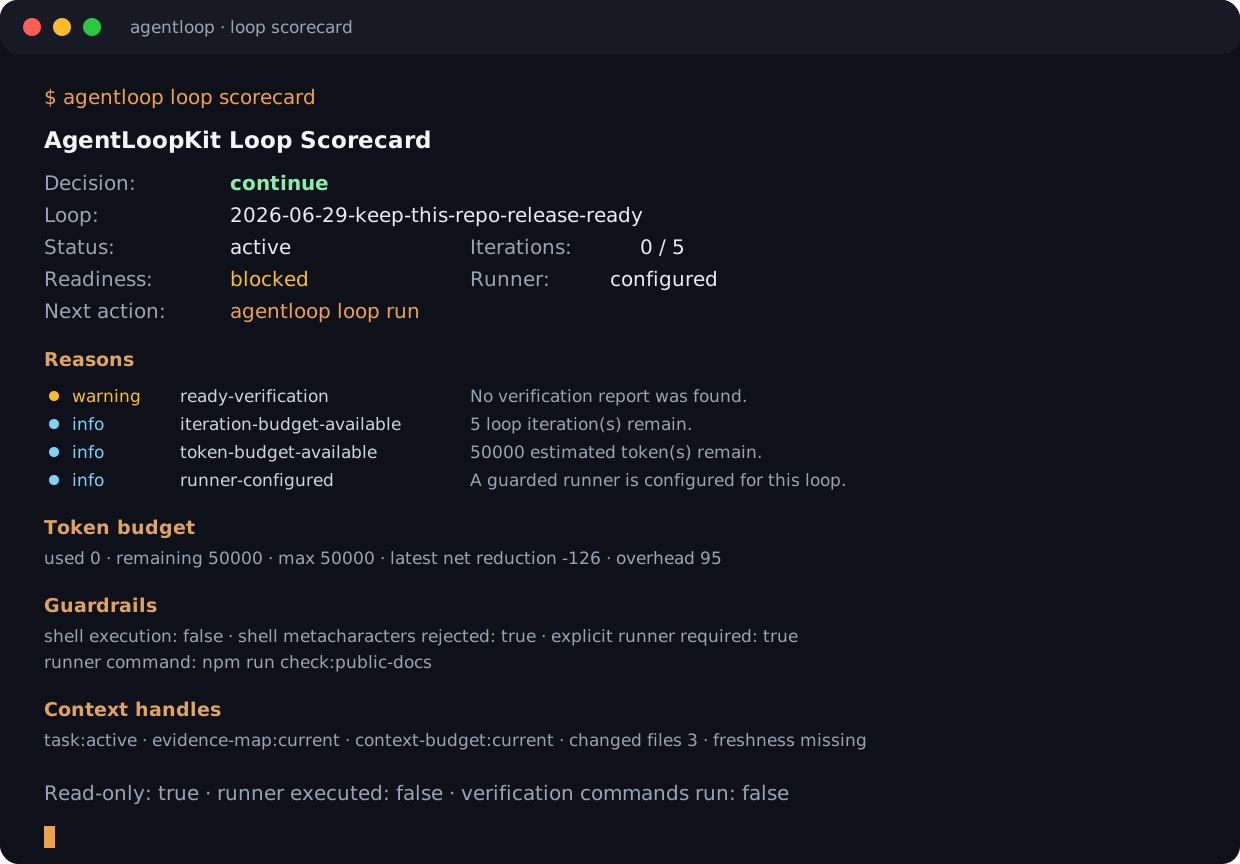
Score the next loop before it spends budget
agentloop loop scorecard reads the loop contract, readiness gates, scope evidence, runner guardrails, token budget, and context handles, then returns the next decision before another iteration runs. Real 1.1.0 output: a continue decision with ranked reasons, read-only and shell-free.
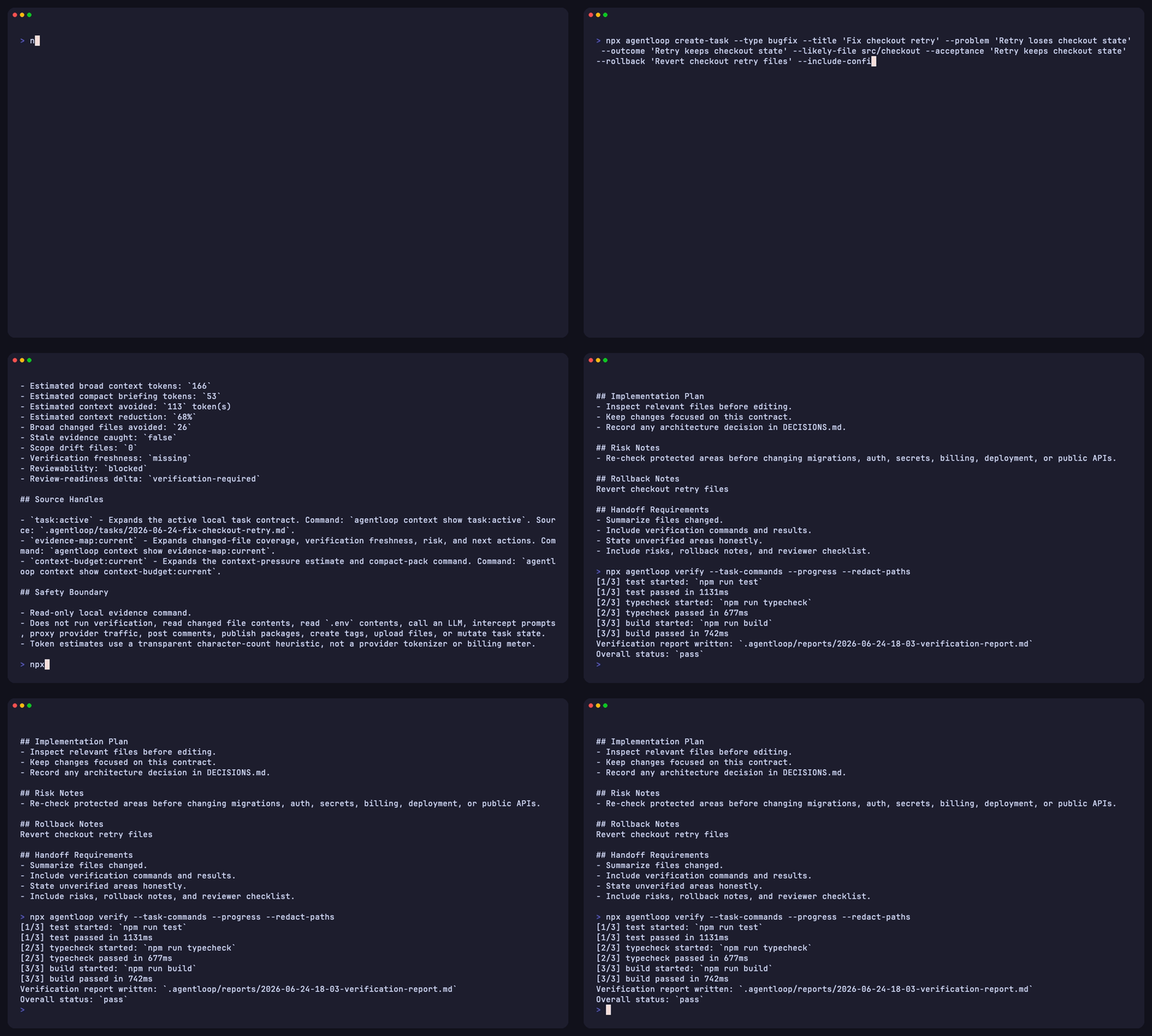
Start: current repo truth before the first edit
agentloop start --for codex --goal implement --redact-paths meets a messy repo with a read-only preflight: read-first source handles, risk and verification status, the estimated context avoided, and a single next safe command. No provider proxy, no prompt rewriting.
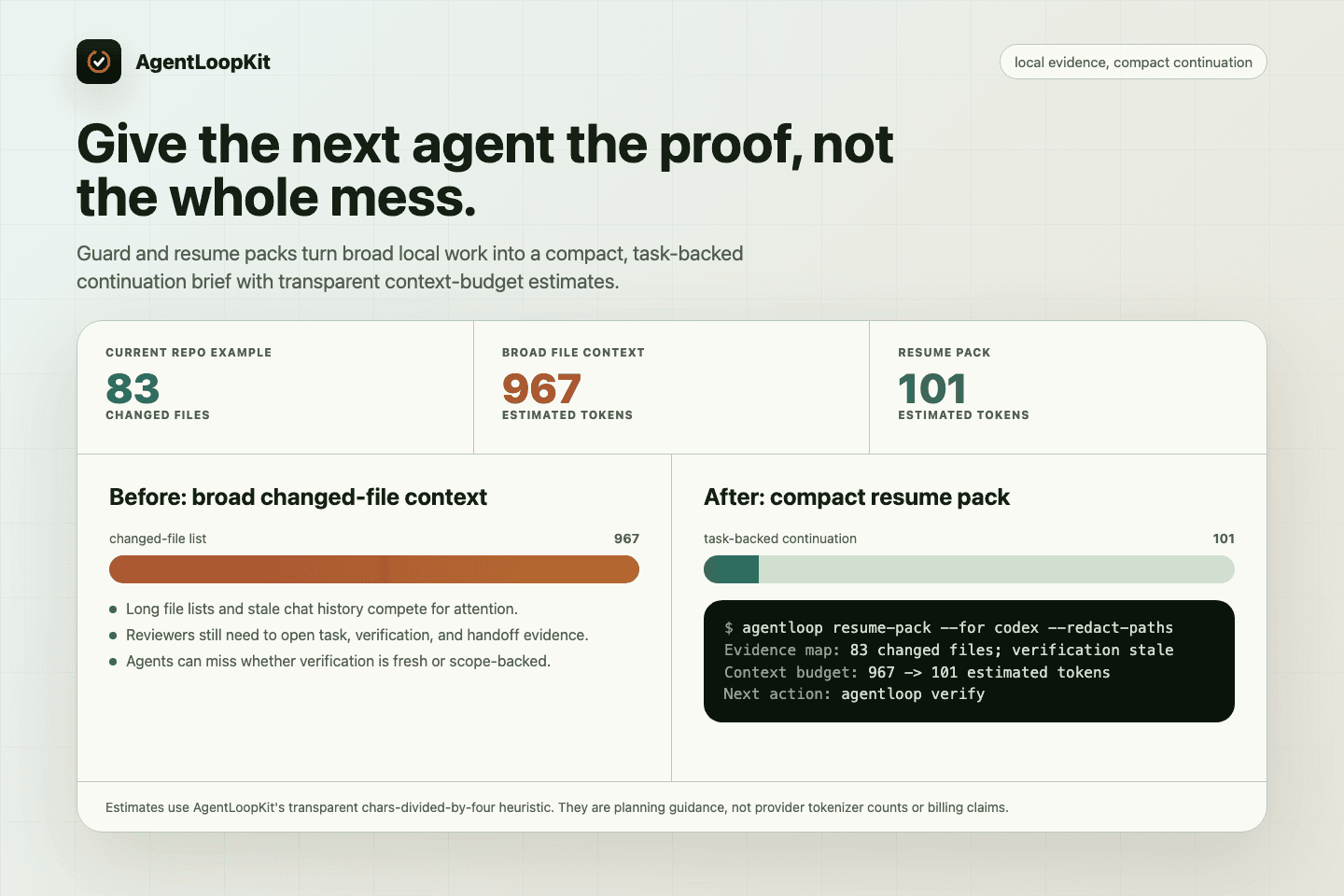
A compact briefing instead of broad context
In the release repo demo, AgentLoopKit estimated a compact briefing roughly 92-96% smaller than broad changed-file context. The figures are local planning signals, not provider billing guarantees, and the receipt names what each handle expands back to.
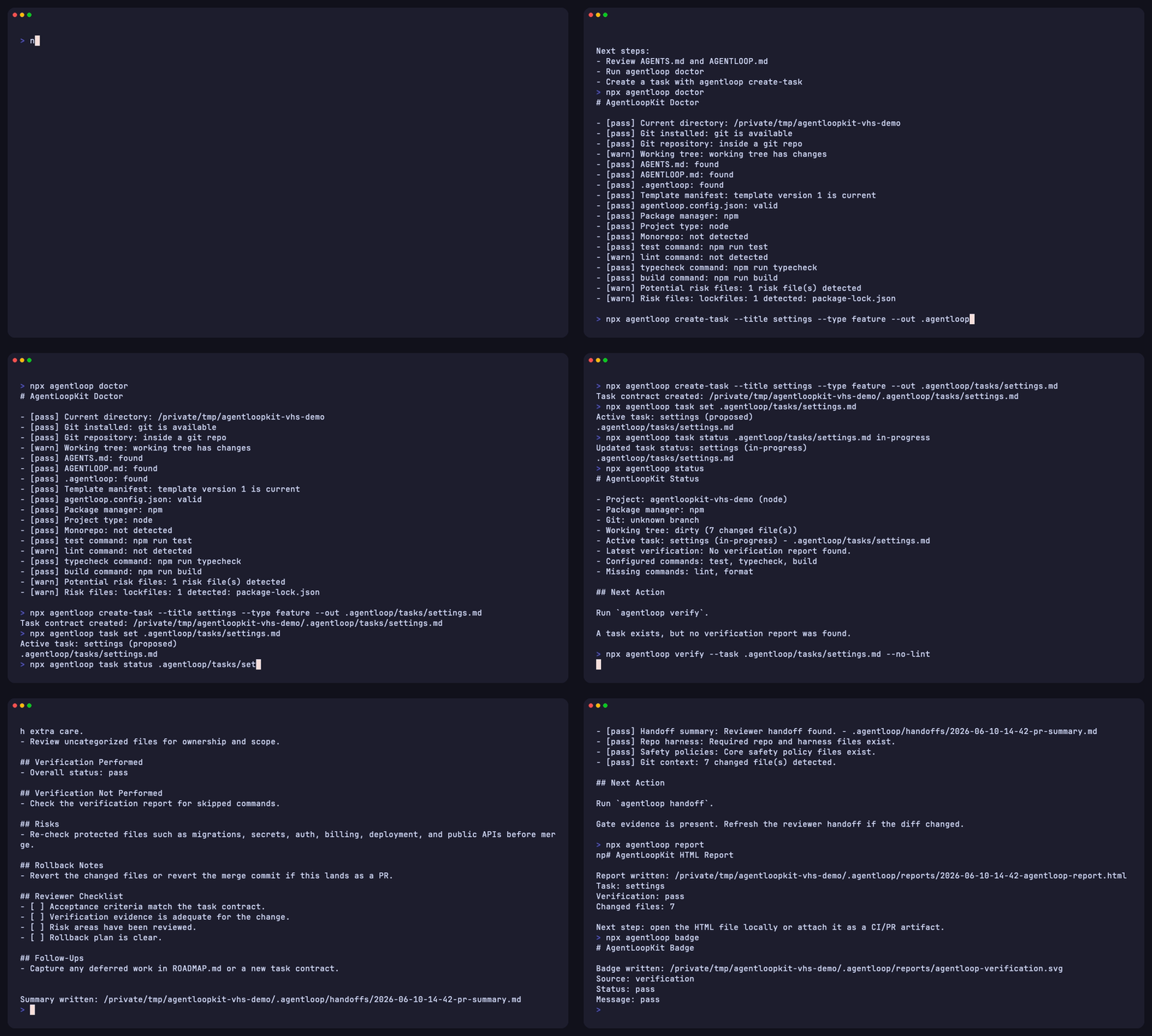
One local loop, init to review
npx agentloopkit init writes the harness, then create-task, verify, and ship run the loop. Each command writes a local file, calls no LLM, and contacts no server.
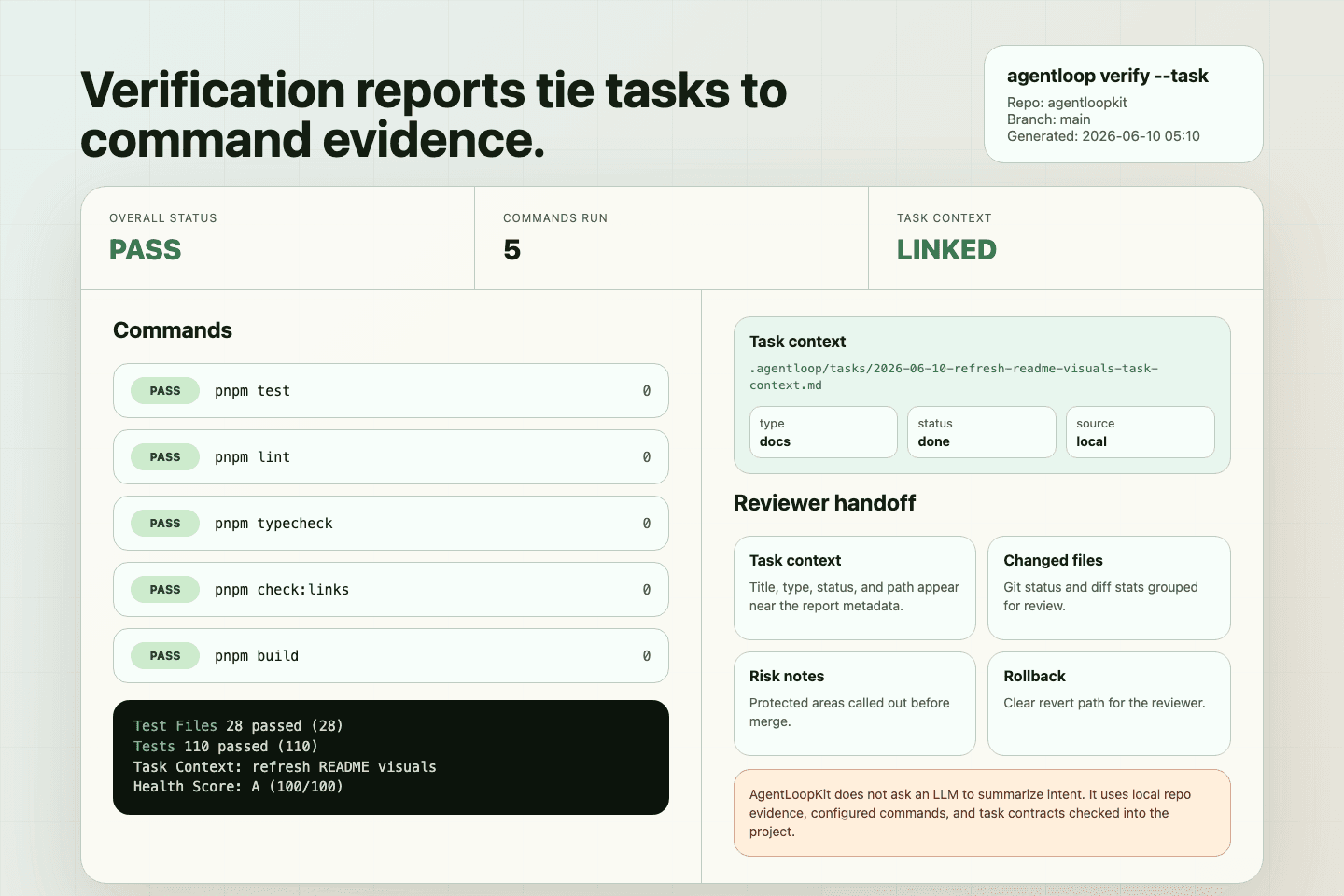
Verification you can audit
agentloop verify runs the repo's configured checks and writes a dated report under .agentloop/reports/. Failed commands keep their exit codes and output, so the evidence reads the same for an agent, a reviewer, or a CI step.
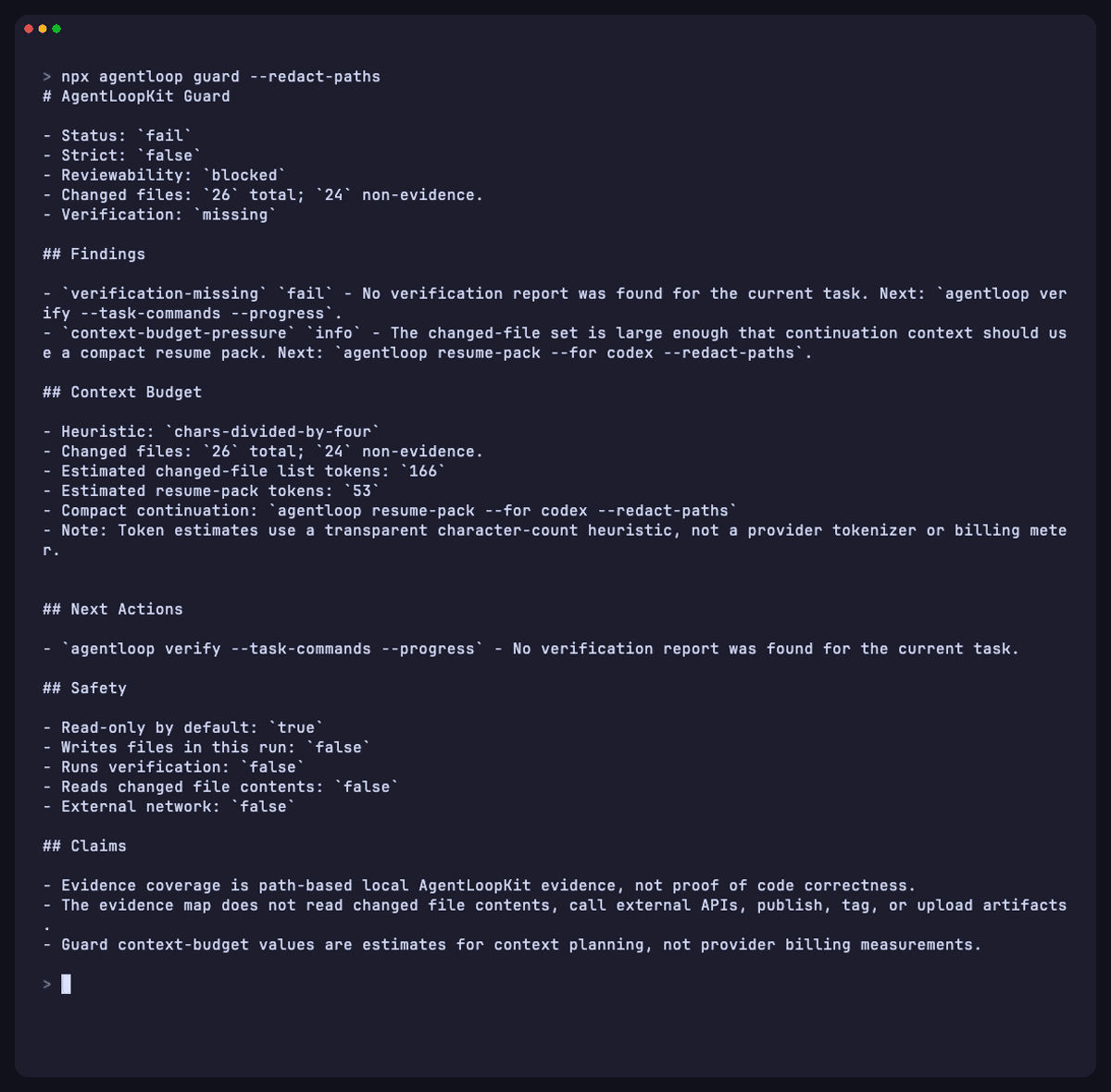
Guard, with a context budget
agentloop guard reports drift, proof debt, and stale verification in one local pass, and prints a context-budget estimate so an agent can hand off compact local evidence instead of broad chat history. The estimate is planning guidance, not a provider tokenizer count or a billing claim.
What's new in 1.2.0
Loops stop dirtying your working tree.
1.2.0: init now keeps per-machine harness state out of git automatically, so loops and run ledgers never show up as working-tree drift. Under it, 1.1.0's reviewer trust holds across the whole loop. A reviewer can approve or reject an agent's work from local evidence alone, in a single pass, without re-deriving what the agent did. AgentLoopKit hardens a task contract before you build, pins freshness to git content so a check can never read false-green, puts each acceptance criterion next to the verification command that proves it, and makes the trust gates fail by default. Everything stays deterministic and LLM-free, and runs on your machine. ProjScan finds the risk, AgentLoopKit controls the work, AgentFlight proves the result.
- Per-machine state stays out of git
initwrites a.agentloop/.gitignorethat keeps machine-specific state untracked: the active-task pointer, loop instance directories, and the local run ledger. Durable evidence stays committed. The harness's own writes no longer dirty your working tree, where a tool that watches the diff would read them as scope drift. Re-runiniton a repo that committed this state under an older version and it prints the exactgit rm -r --cached ...command to un-track it, without ever runninggit rmitself.- Harden the contract before you build
agentloop hardeninterrogates a task contract for unresolved soft spots (placeholder sections, untestable acceptance criteria, unbounded scope, unstated assumptions, and contradictions with Non-Goals) before implementation starts, so you fix a thin contract at the front of the loop instead of at review. Deterministic and LLM-free.- No false-green checks
- Fresh, covered, and verified are now pinned to git content hashes, not timestamps or file paths. Edit a file after a passing verification and its freshness reads stale, so a stale edit can never slip through as verified.
- Promise vs. evidence, side by side
- The PR and handoff packet shows which acceptance criteria are proven by a passing verification command, and which changed files are not tied to task intent. The reviewer reads intent against change, not just a diff.
- Gates that bite by default
- Blocking soft spots now fail
check-gatesand blockreadyby default (opt out with--allow-soft-spots),shipreports which verification commands were skipped, andcreate-tasksurfaces soft spots at creation time. - Hardened before release
- 1.1.0 shipped after a two-round adversarial hardening pass: several correctness and security fixes, each landed with a regression test. Every release publishes to npm with SLSA provenance, and also ships to GHCR and the MCP Registry.See the changes on GitHub
Loop controls
Drive the whole loop from one local control plane.
AgentLoopKit is the local control plane for low-token, verifiable agent loops. Loop controls drive the work step by step, a decisive readiness gate calls whether work can proceed, and a token receipt prints on every step. It owns the middle of the Baseframe loop: task scope, acceptance criteria, verification gates, and completion decisions. Everything runs locally and read-only where it reads.
- Drive the loop
agentloop loop createopens a controlled loop around the active task,agentloop loop tickadvances it one verified step,agentloop loop statusshows where it stands, andagentloop loop reportwrites a loop report under.agentloop/loops/. The loop holds the work to the contract instead of letting an agent run unbounded.- Readiness gate
agentloop readyreturns a decisive ready or not-ready answer from local evidence: task clarity, fresh verification, gate compliance, and risk flags. Use it before an agent starts, before a tick advances, and before a task reads complete.- Token receipts
- Every loop step prints a token receipt with four lines: the estimated broad context, the compact context AgentLoopKit hands over instead, AgentLoopKit's own overhead, and the net context reduction. The figures are transparent local planning estimates, not provider tokenizer counts or billing claims.
- Unchanged receipts
- Context handles carry a digest, so
agentloop context show --since <digest>reports an unchanged receipt when the underlying evidence has not moved. The next worker can trust a cached handle instead of re-expanding it. - Owns the decision
- AgentLoopKit decides when work is in scope, verified, and done. ProjScan and AgentFlight hand it evidence; the completion decision stays here, recorded in local files you can read.
Baseframe Suite v1
Baseframe Suite Integration.
ProjScan finds the risk, AgentLoopKit controls the work, and AgentFlight proves the result. The suite connects the three through local versioned JSON under .baseframe/: AgentLoopKit imports a ProjScan assessment, owns the machine-readable task contract, updates the workflow manifest, and reconciles AgentFlight verification against the required gates. The tools stay separate and local-first; nothing merges.
- Import a ProjScan assessment
agentloop create-task --from-projscan .baseframe/evidence/<task-id>/projscan-assessment.jsonreads ProjScan's repository assessment and writes a native AgentLoopKit task with scope, acceptance criteria, and verification gates.- Own scope, gates, and the decision
- AgentLoopKit emits
.baseframe/evidence/<task-id>/agentloopkit-task.json, a machine-readable task contract for AgentFlight, and updates.baseframe/agent-workflow.json. It owns task scope, acceptance criteria, verification gates, and completion decisions; ProjScan and AgentFlight each own their own artifact. - Reconcile AgentFlight later
agentloopkit check-gates --task <task-id> --from-agentflight .baseframe/evidence/<task-id>/agentflight-result.jsonmatches AgentFlight's recorded proof to the required gates by verification command, surfacing passed, failed, missing, and incomplete results, plus scope drift and proof gaps. A task never reads complete while a required gate fails or is missing.- Assessment evidence, not acceptance criteria
- A ProjScan assessment carries risk, not finished acceptance criteria. When AgentLoopKit cannot infer criteria safely, it writes placeholder criteria and holds readiness until a human completes them.
- Still fully standalone
- The integration is opt-in.
create-task,verify,ship,prepare-pr,check-gates, Start, the Context Contract, MCP, and the GitHub Action all work without ProjScan or AgentFlight. No cloud backend, no telemetry, no LLM required.
Start here
One command, current repo truth before the first edit.
Run agentloop start --for codex --goal implement --redact-paths and an agent gets a compact, read-only briefing in place of a broad repo scan.
- Read first
- The active task and current work, the evidence map, and the latest verification, so the agent starts from what the repo already knows.
- Do not broad-scan
- A compact briefing with local source handles, so the agent loads broad files only when it needs them.
- Risk
- Stale proof, scope drift, and risky files when present, surfaced before the first edit rather than after review.
- Impact
- An estimate of the context avoided. It is a local planning signal, not a provider billing figure.
- Next command
- A single next safe command, usually
agentloop context show <handle>to expand a source handle back to full local evidence.
Context Contract
The AgentLoop Context Contract.
Before an agent starts work, AgentLoopKit packages the exact local evidence it needs, why it matters, what was omitted, and how to expand the source truth. The context commands run locally and read-only, call no LLM, and leave the source truth in your repo.
- Measure context pressure
agentloop context budgetreports transparent context-budget estimates for the local evidence in play, so an agent sees the pressure before it pastes broad file or history context. The estimates are character-count heuristics for planning, not provider tokenizer counts or billing claims.- Build an auditable pack
agentloop context pack --for codex --goal continue --redact-pathswrites a continuation pack with a receipt: the included evidence, the broad context it omitted, the source handles, verification freshness, and the next actions. A pack is often much smaller than broad file or history context, depending on repo state. Goals cover continue, review, debug, handoff, and research.- Expand the source truth
agentloop context show task:activeexpands a reversible local source handle back to its full evidence. Handles cover task:active, verification:latest, run:latest, evidence-map:current, and context-budget:current, so a reviewer can trace a pack back to the repo.- Same tools over MCP
- The read-only MCP server exposes
agentloop_context_budget,agentloop_context_pack, andagentloop_context_show, so an agent platform consumes the same context contract directly. No LLM calls, no provider proxy, no prompt interception, no telemetry.
Workflow
From request to review-ready PR.
One loop runs from a plain request to a PR a reviewer can trust. Each step is a command you hand to the next agent or maintainer.
- Specify the task
- Turn a request into a scoped contract before the first edit.
npx agentloopkit create-task --type bugfix --title "Fix checkout bug" - Let your agent implement
- Use Codex, Claude Code, Cursor, OpenCode, Gemini CLI, Copilot CLI, or another software agent inside the repo. AgentLoopKit does not replace your agent. It holds the work to the contract.
- Verify evidence
- Run the repo's configured checks and capture the result as a dated report.
npx agentloopkit verify - Ship the review packet
- Score review readiness from evidence and write a ship report.
npx agentloopkit ship - Prepare the PR
- Generate a PR title, body, grouped files, evidence, and a reviewer checklist.
npx agentloopkit prepare-pr - Help maintainers review
- Evaluate an agent-assisted PR against task evidence, fresh verification, and risky areas.
npx agentloopkit maintainer-check
Trust
Local-first, and intentionally boring.
AgentLoopKit only writes transparent repo files, and only when you run a command. Nothing runs on install, and nothing leaves the machine.
- No install scripts, no telemetry
- No postinstall script, no telemetry, no cloud backend, no database, no API key, and no hidden network calls.
npm install agentloopkitruns no AgentLoopKit code. - Commands run only when you invoke them
- Nothing happens in the background. Each command does one thing when you run it, writes repo-local files, and contacts no server.
- Repo-local files only
- AgentLoopKit writes inside the current repository:
AGENTS.md,AGENTLOOP.md,agentloop.config.json, and.agentloop/. It does not touch your root.gitignore, global Git config, or shell profiles. The one.gitignoreit writes lives inside.agentloop/and covers only its own per-machine state. - Never reads your secrets
verify,ship, the run ledger, and the MCP server do not read.envcontents or print arbitrary environment variables. They read what the loop already wrote.
Score the loop, then run a guarded iteration.
Install the control plane in an existing repo, create a loop with a runner and a context budget, score the next iteration before it spends budget, run one guarded iteration, check readiness, then write a loop report. AgentLoopKit owns the goal, scope, gates, and stop conditions, never the code. Local-first, MIT, no cloud.
Install the control plane
Create a guarded loop
Score the next loop
Run one guarded iteration
Check readiness
Write a loop report
More from the studio
ProjScan
ProjScan tells reviewers when to bootstrap, prove, or stop. Review Gate returns one decision; bootstrap is explicit. Local proof, no code upload.
ViewAgentFlight
agentflight guard watches local trust while your coding agent works; agentflight finish writes the Review Passport that proves the result.
ViewVerisKit
veris runs the test and quality tools you already have, then returns one honest verdict, verified, failed, or partial, plus a PR-ready report.
View